
A flush casement has an opening sash that sits broadly level with the outer frame when closed. A standard casement usually has a sash that stands slightly forward of the frame. That visual difference is the main reason to choose between them; colour, glazing, hardware and the complete specification still determine how the finished window performs and looks.
The useful comparison
| Point | Flush casement | Standard casement |
|---|---|---|
| Closed sash | Sits broadly level with the frame externally | Usually projects from the frame |
| Character | Cleaner, flatter sightline | Familiar modern uPVC appearance |
| Best reason to choose | External style and proportions | Flexible, straightforward layouts |
| Still needs checking | Opening layout, glazing, ventilation, colour, hardware and planning constraints | |
What “flush” does—and does not—mean
Flush describes how the opening sash relates to the frame. It does not mean frameless, and it does not automatically make one window more energy efficient, secure or suitable for a protected building. Those claims depend on the tested product, glass, hardware, installation and project requirements.
Our flush casement window page focuses on that flatter external appearance. For conventional layouts, see our casement windows and the guide to casement opener styles.
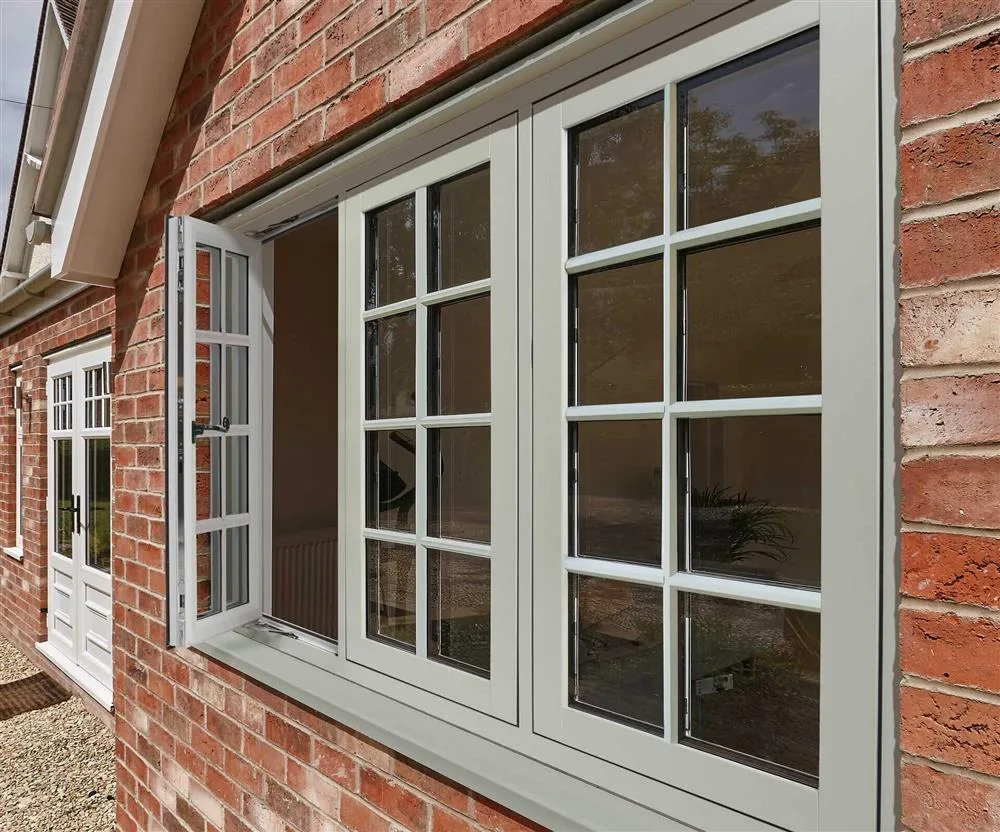
Which appearance suits the property?
Flush frames can give a restrained look that works well where bulky projecting sashes would distract from the elevation. Standard casements remain a practical choice when the aim is to reproduce an existing modern arrangement or create a particular combination of top- and side-hung openers.
Do not judge from a close-up sample alone. Ask for an elevation showing mullions, transoms, fixed panes and opening sashes. Equal glass sizes may require different frame choices, and a dummy sash—if offered—changes both sightlines and cost. Confirm the actual configuration rather than assuming every pane will look identical.
Colour and finish change the effect
A flush sash is often chosen for a restrained external face, but colour and surface finish can make as much visual difference as the sash position. View a full frame sample outdoors if possible: a small colour chip will not show joints, gasket lines, frame depth or how the finish responds to daylight. Confirm whether the internal and external colours are the same and how trims, cills and vents will be finished.
Maintenance access matters too. Establish how hinges, locks, gaskets and drainage paths will be inspected and cleaned. A neat elevation at handover is only part of the decision; the window also needs to remain usable and serviceable in its actual room.
Planning and performance remain separate checks
In conservation areas or listed buildings, a flush profile is not an automatic substitute for an original timber sash-and-case window. Check Glasgow City Council’s window guidance, the Scottish Government’s permitted development explanation and the property’s designation through Historic Environment Scotland before ordering.
For comfort and energy use, compare the declared whole-window specification rather than the word “flush”. Energy Saving Trust provides an independent overview of window efficiency. The parent company also explains its flush sash window service.
Questions to ask before choosing
- Can I see the complete window elevation, not just a profile corner?
- Which panes open, and in which direction?
- Will fixed and opening panes have equal or different sightlines?
- What whole-window performance is declared for this exact size and glazing?
- Does the proposed appearance suit the building and any planning controls?