

uPVC sliding sash windows can be a practical replacement where easier maintenance and a sash-style appearance are priorities. Timber remains the appropriate choice where original fabric, exact historic detailing or planning requirements demand it. In Glasgow’s period buildings, the decision should begin with the property’s status and the existing window—not with material preference alone.
uPVC and timber sash windows compared
| Question | uPVC sliding sash | Timber sash and case |
|---|---|---|
| Maintenance | Routine cleaning and hardware care; no repainting | Requires inspection and periodic finishing or repair |
| Historic detail | Can reference sash proportions but is not original timber construction | Can retain or reproduce traditional material and joinery detail |
| Planning fit | Property-specific; never assume acceptance | Often favoured where original fabric or exact replication matters |
| Buying focus | Profiles, meeting rails, horns, glazing bars and opening action | Repairability, timber condition, cords, weights, putty and glass |
First ask whether the existing windows can be retained
Traditional sash-and-case windows were designed to be maintained. Draughts, stiff movement or failed paint do not automatically mean full replacement is necessary. Historic Environment Scotland explains practical ways to reduce heat loss from sash windows, including repair and secondary measures.
If replacement is justified and uPVC is acceptable for the property, our sliding sash window page shows the modern option. Compare the actual frame proportions and details rather than relying on the words “heritage” or “traditional”.
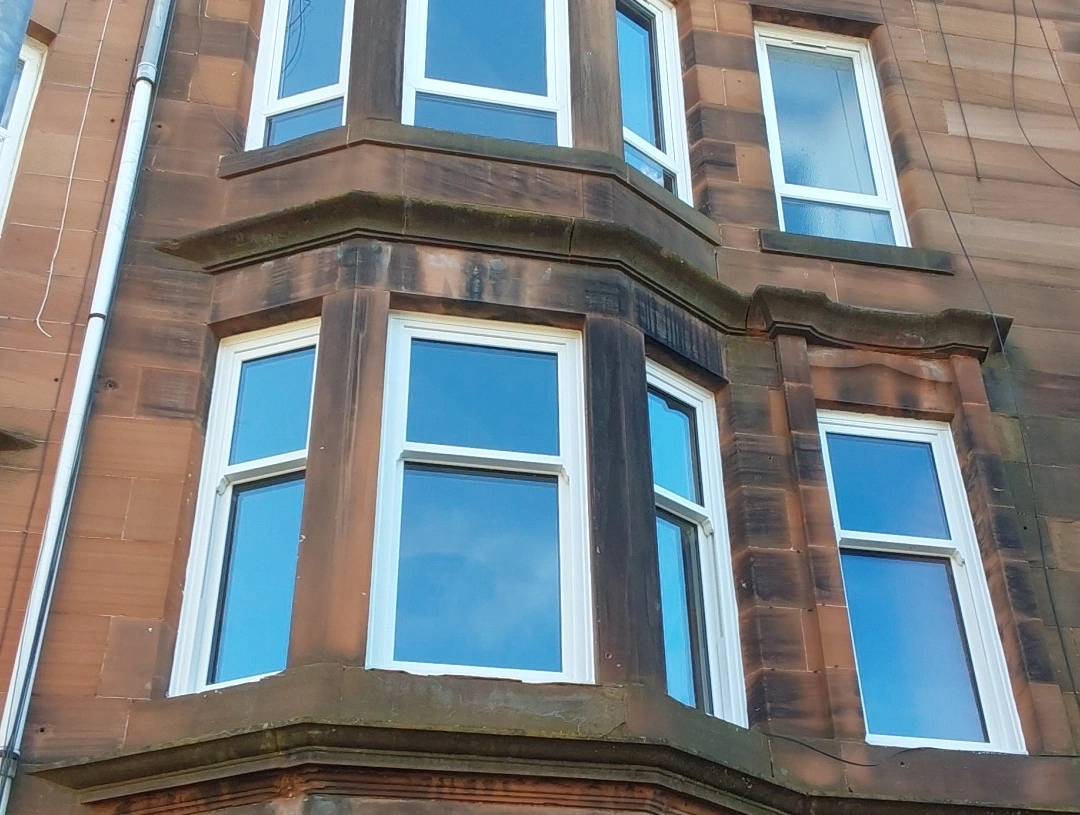
Look closely at the elevation
In a tenement or terrace, one window forms part of a larger composition. Meeting-rail height, pane divisions, horns, frame depth, colour and reflections can affect how well a replacement sits alongside neighbouring windows. Ask for an external elevation and clarify whether glazing bars are integral, bonded or merely decorative.
Understand how the two constructions differ
A traditional sash-and-case window normally balances moving timber sashes using weights and cords concealed in the case. A modern uPVC sliding sash uses its own profile, seals, balances and hardware to create a vertical sliding action. Similar overall proportions do not make the constructions identical. Ask to operate a full-sized sample and inspect the meeting rails, bottom rail, horns, glazing bars and frame depth.
That distinction also affects repair. Individual timber components may be repairable by a suitably experienced craftsperson, whereas replacement parts for a uPVC sash depend on its specific system and hardware. Ask what aftercare information and replacement-component route will be provided.
Our guide to replacement windows and planning in Glasgow explains the checks in more depth. Glasgow City Council also publishes direct window-replacement guidance, and the Historic Environment Scotland portal can help identify designations.
Compare complete specifications
Material is only one part of the decision. Compare how the sashes move, how ventilation is provided, the whole-window thermal specification, glass type, restrictors where required, hardware access and how the installation will be made good. Energy Saving Trust’s windows guidance provides a neutral overview of glazing and heat loss.
The practical rule is simple: retain and repair sound historic timber where that is the appropriate conservation solution; consider a carefully detailed uPVC sash where replacement is justified and permitted. The parent company’s uPVC sash-and-case service provides further product context.
For a wider buying sequence, use our Glasgow window replacement guide before arranging surveys.